Free printable chart
Cello fingerboard chart, free printable first position
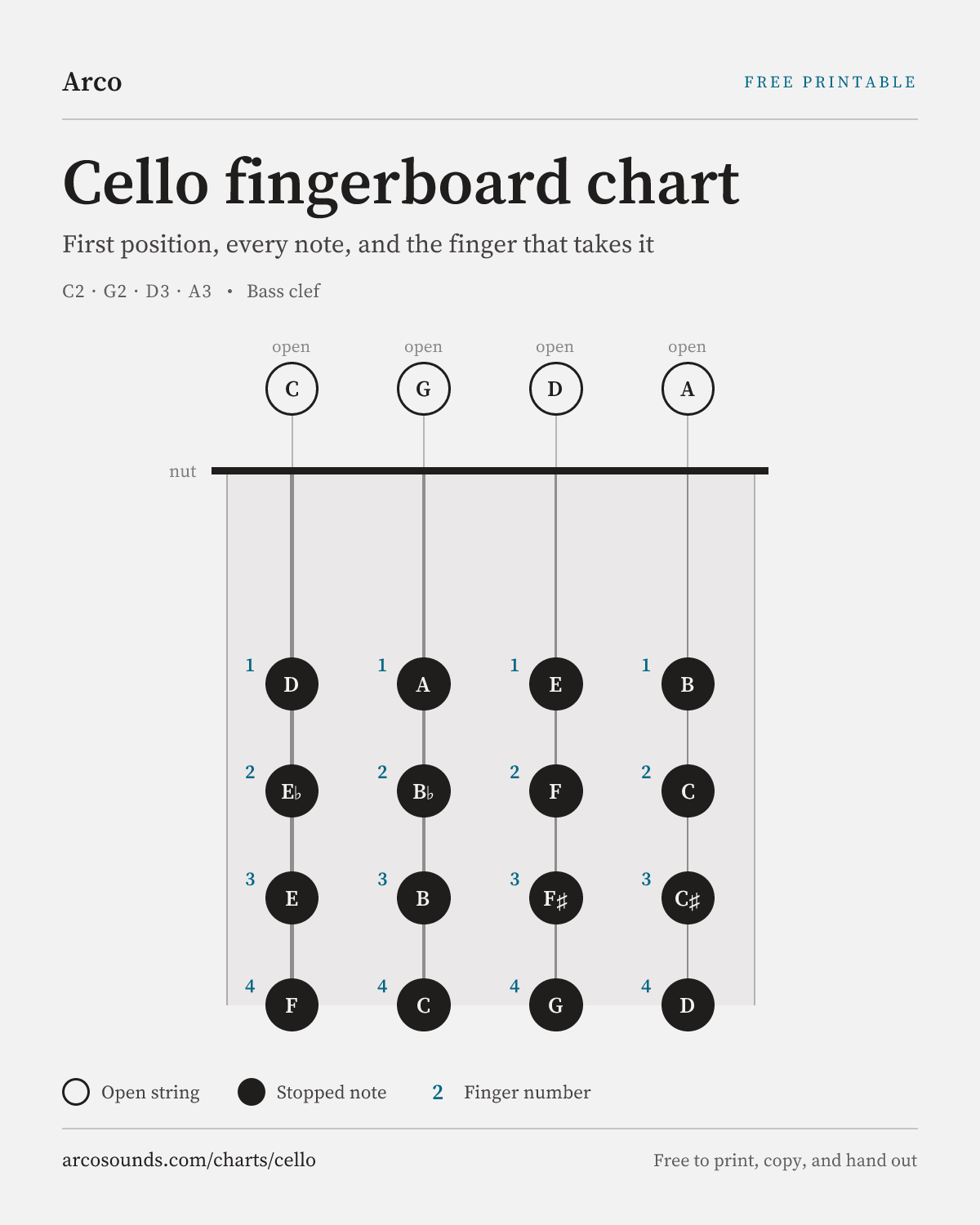
First position on all four cello strings, in the normal frame, open string, then fingers one, two, three, and four.
Practise one string at a time
Each string has its own note table, short exercise and one-page PDF. These references show the selected first-position pattern, not every accidental or higher position.
Save it as an image
The same chart as a single picture, for a phone lock screen, a slide, a class page, or a group chat. It carries its own title and address, so it still says what it is after it has been forwarded three times.
- Format
- PNG · 1200 × 1500
- Licence
- Free to use and share
Prefer paper? The version above this one is built for a printer and comes out clean in black and white.
Every note on the chart
The same information as the diagram, written out, open string first, then each finger.
- C string
- CDE♭EF
- G string
- GAB♭BC
- D string
- DEFF♯G
- A string
- ABCC♯D
How to read it
The cello hand works differently from the violin's. The string is long enough that the four fingers span only a minor third in first position, so the frame is open string, whole step to first finger, then a half step to each of second, third, and fourth. That is the normal frame this chart shows.
Strings run vertically, lowest on the left, nut across the top. Open strings sit above the nut as hollow circles; stopped notes are filled, with the note name inside and the finger number beside it.
The chart does not show extensions. Moving the first finger back, or the upper fingers forward, can widen the normal frame for particular notes. These movements need a relaxed, coordinated hand and are best learned with guidance rather than by stretching to match a diagram.
What a chart cannot tell you
- This is the normal, unextended frame. Forward and backward extensions change the spacing and are taught as a separate hand shape.
- The thumb sits behind the neck opposite the second finger in first position. If it creeps forward, the frame collapses, a chart cannot warn you about that.
- Cello spacing compresses sharply as you move up the fingerboard. First position spacing does not transfer to fourth.
Printing and sharing it
Open the print dialog
Press Ctrl+P on Windows or Cmd+P on a Mac, or choose Print from your browser menu.
Check the preview
The chart appears alone on one sheet, the navigation and the text around it are removed automatically, and colours are set to black on white so it photocopies cleanly.
Print, or save as PDF
Print it directly, or choose "Save as PDF" as the destination to get a file you can email to a student or a section.
Teachers are welcome to print these for a class or a section and hand them out. The chart carries its own address in the footer, which is all the credit we ask for.
Cello chart questions
- What are the notes on a cello in first position?
- On the C string: C, D, E flat, E, F. On the G string: G, A, B flat, B, C. On the D string: D, E, F, F sharp, G. On the A string: A, B, C, C sharp, D. That is the normal frame, open string, first finger a whole step up, then a half step to each following finger.
- Why does the cello use fingers 1, 2, 3, and 4 differently from the violin?
- Because the string is much longer. A cellist's four fingers cover only a minor third in first position, where a violinist's cover a perfect fourth, so each finger takes a half step rather than alternating whole and half steps. This is also why cellists use extensions and shift more often.
- What is a cello extension?
- An extension temporarily widens the normal frame, either by taking the first finger back or the upper fingers forward, depending on the notes. It can reach notes outside the normal frame without a full shift. Coordinate the movement with your teacher; do not force a stretched hand shape.
- How do I print this cello chart?
- Choose Download the PDF for a ready-made one-page file, free without an account or email. Print it at fit-to-page scale in black and white, or use the browser print button for the on-page chart.
A chart shows you where. Arco shows you why.
The cello curriculum builds the hand frame this chart describes, with the staff, the keyboard, and the fingerboard shown together on every concept.